Open the text messages on my phone and you'll find a cross-section of the problem:
- political fundraising appeals
- loan offers
- pitches to help my company raise money or fix its go-to-market strategy
- friendly strangers asking how my day is going, a pattern the FTC associates with scams[1]
- links from companies I've never heard of, including what look like fake two-factor authentication codes
Mixed in with all of that are legitimate messages from businesses I probably did sign up with. I just don't remember every subscription, so I ignore those too.
It has gotten bad enough that I miss texts from friends and family.
I own a text messaging company, and I think about this channel every day. If I've stopped paying attention to my own messages, it's worth asking what that costs the organizations trying to reach people like me. America's toll agencies have already found out.
In March 2025, North Carolina's attorney general and the state's Turnpike Authority warned that NC Quick Pass was receiving thousands of phone calls a day from people asking whether toll texts were real.[2] Colorado's E-470 toll road, whose call center averages 5,000 calls a day, reported a 443% jump in scam reports in a single month.[3] The Pennsylvania Turnpike went furthest. In March 2026 it told drivers plainly that it does not text E-ZPass or Toll By Plate customers.[4] Seven weeks later it announced a pilot to start texting drivers with unpaid tolls. The messages would not ask for payment, and drivers would be told in advance what they would say and which number they would come from.[5]
Think about what that means. A public agency needs a channel that criminals have poisoned. To use it, it has to publish instructions for recognizing its own messages. None of these agencies committed the fraud, yet all of them are paying for it.
I call that the trust tax. Almost every organization that texts or calls its customers now pays it, including those that have never been impersonated.
The tax also compounds. When a channel fills with fraud and noise, people don't just distrust individual messages. They stop looking.
An old idea with a new collector
The idea that distrust works like a tax is not new. Francis Fukuyama argued in 1995 that widespread distrust acts as a tax on nearly all economic activity, because every transaction needs more checking, contracting and enforcement.[6] Stephen M.R. Covey later popularized the phrase "trust tax": when trust falls, speed falls and cost rises.[7]
Covey was mostly describing trust an organization earns or loses through its own conduct. The tax I'm describing is different. Honest organizations pay it because of what other people do.
Economists recognized that structure long ago. In "The Market for 'Lemons,'" George Akerlof showed that when buyers can't tell good products from bad ones, dishonest sellers impose costs on honest ones. Among the costs of dishonesty, he counted "the loss incurred from driving legitimate business out of existence."[8]
Security economists have since tried to measure those costs:
- Spam: Rao and Reiley estimated that spam cost American firms and consumers about $20 billion a year, while spammers earned about $200 million. That is roughly one hundred dollars of cost for every dollar of criminal revenue.[9]
- Cybercrime: Anderson and colleagues found that indirect losses and defense costs can run to ten times what criminals actually collect.[10]
The criminal's revenue is the small part of the bill.
The size of the problem
In 2025, Americans reported losing $3.5 billion to imposter scams to the Federal Trade Commission. That included nearly $1 billion lost to people impersonating businesses and about $920 million to people impersonating government agencies.[11] Reports of government impersonation rose 40%, driven in part by fake toll texts.[12]
Text has become the front door:
- Contact method: When people told the FTC how a scam first reached them in 2025, text messages topped the list. Total reported fraud losses that year were $15.9 billion.[13]
- Under-reporting: The FTC has cited research estimating that fewer than 5% of mass-market fraud victims ever complain to a government agency or the Better Business Bureau.[13]
Voice remains a major channel too:
- Cybercrime overall: The FBI's Internet Crime Complaint Center recorded $20.9 billion in reported cybercrime losses in 2025.[14]
- Fake bank staff: In a separate November 2025 alert, the FBI counted more than 5,100 complaints and $262 million in losses from criminals posing as bank employees by text, call or email, often with spoofed caller ID.[15]
- Spoofed bank numbers: In a 2026 Bank Policy Institute study, two participating banks found that 40% of calls appearing to come from their own phone numbers were spoofed.[16]
Every signal a customer checks can be counterfeited
For years, consumers were taught to check. Look at the number. Look at the link. Listen to the voice. Criminals can now defeat each of those checks.
Numbers. Caller ID spoofing lets a criminal display a bank's real number, or a sheriff's. In August 2026, a school employee in Fort Bend County, Texas, lost $50,000 after a call that appeared to come from the sheriff's office, followed by fake warrants sent by text.[17]
Links. In November 2025, Google sued the operators of "Lighthouse," a phishing kit sold to criminals and used for fake toll and package-delivery texts. Google said it had reached more than a million victims in 120 countries.[18] Two months earlier, Microsoft obtained a court order to seize 338 websites that one phishing service used to imitate its sign-in pages.[19]
Voices. In January 2024, New Hampshire voters received robocalls with an AI-generated imitation of President Biden's voice. The FCC responded by ruling that AI-generated voices count as "artificial" under the Telephone Consumer Protection Act.[20] It later fined the political consultant behind the calls $6 million, although a jury acquitted him of the related criminal charges in 2025.[21] The FBI has since warned that criminals are using AI-generated voice messages to impersonate senior US officials.[22]
The implication is uncomfortable. A familiar number, a plausible link and a fluent message were never proof of authenticity, but they used to be reasonable proxies. They no longer are. Michael Spence's signaling theory explains why: a signal carries information only when it is costly for the wrong party to fake.[23] Today those signals cost a criminal almost nothing.
Where the tax is paid
This is where organizations that have never been targeted pay. Customers carry the uncertainty created by scams into every text and call they receive, including the legitimate ones.
The best available data comes mostly from companies that sell caller-identification and messaging services, so readers should weigh it accordingly. It still points in one direction:
- 70% of consumers told TransUnion they had missed legitimate business calls because of fraud concerns.[24]
- 82% told Truecaller they had ignored important calls or texts for fear of scams.[25]
- Hiya found that 86% of consumers won't answer calls that aren't identified.[26]
The tax shows up in at least five lines on the ledger:
- Lost response. Customers ignore reminders, leave fraud alerts unanswered and don't click legitimate links.
- Verification cost. Customers call to check whether a message is real. North Carolina's thousands of calls a day are the clearest example.[2]
- Degraded channels. Organizations disown or narrow their own channels.
- The US Postal Inspection Service tells the public that genuine USPS tracking texts will not contain a link.[27]
- E-ZPass Virginia publishes the only numbers its genuine texts come from.[28]
- The Social Security Administration's Office of the Inspector General goes further. It tells the public that when an unexpected call or text claims to come from that office, they should think "scam first."[29]
- Borrowed suspicion. When scammers impersonate you, customers wonder whether you were breached. E-ZPass Virginia had to reassure its customers that there had been no data breach.[28]
- Defense spending. Organizations pay for warnings, call-center staff, monitoring and public education campaigns.
Why behind-the-scenes controls aren't enough
The industry has built real controls, but the customer never sees them.
Text. Businesses that text from ten-digit numbers register their brands and campaigns. Toll-free senders go through verification. Short-code programs undergo carrier vetting and ongoing audits.[30] These controls reduce abuse, but a registered message still arrives from a number. As a GSMA guideline observed, SMS does not allow the recipient to confirm the sender's identity.[31]
Voice. STIR/SHAKEN, the framework the FCC required carriers to implement between 2021 and 2023, authenticates whether the originating carrier vouches for a caller's right to use a number. In an October 2025 proposal, the FCC itself acknowledged the limit: the framework can flag a spoofed number, but it doesn't tell consumers who is calling.[32] Industry filings cited in the FCC's December 2025 report to Congress show why that matters. Scam calls receive the highest level of attestation more than half the time.[33] The system checks the number, not the business.
That is the gap. The customer decides whether to trust a message on the screen, in a few seconds. The verification happens somewhere else.
Verification at the point of decision
The answer is to put verified identity where the customer decides. For text messages, that means RCS. For calls, it means branded caller ID.
RCS: a verified sender inside the messaging app
RCS (Rich Communication Services) is the carrier messaging standard succeeding SMS in phones' built-in messaging apps. No separate app is required. Google has reported more than a billion RCS messages sent every day in the United States.[34]
What matters for trust is how a business gets to send them:
- Brand verification. Before a business sender launches, an authorized representative of the brand must confirm the sender's details and the business's right to manage it.[35]
- Carrier approval. Each carrier reviews and approves the launch separately.[36]
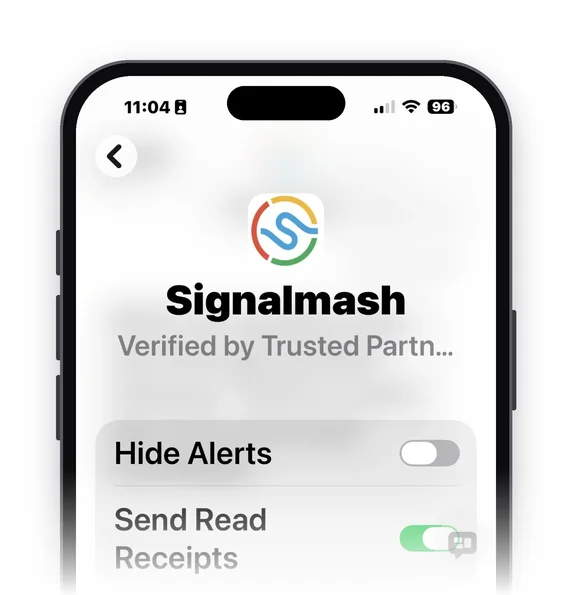
- What the customer sees. After launch, the business name and logo appear in the messaging app, marked as verified. On Android, Google Messages shows a verification checkmark.[35] On iPhone, the sender's profile shows the business name and logo with the label "Verified by Trusted Partner."
- Abuse controls. Google describes further protections, including link scanning, suspension of abusive business senders and one-tap spam reporting.[37]
RCS also changes what a message can do. Customers can tap a button to confirm an appointment, open a booking page or call the business, instead of typing keywords or copying unfamiliar links. The message becomes a place to act, from a sender the customer can verify.
It's worth being precise about the limits:
- Reach varies. RCS availability depends on the handset, the messaging app and the carrier, and presentation can differ between Android and iPhone.[38]
- Fallback loses the badge. Messages that fall back to SMS don't carry the verified identity, so fallback messages need to identify the business clearly and use a recognizable domain.
- Verification isn't endorsement. It establishes who is speaking, not whether the message is useful or wanted.
Branded caller ID: a verified name on the call screen
For voice, the equivalent is branded caller ID. New industry standards let a carrier sign a caller's name, logo and reason for calling and carry them alongside the STIR/SHAKEN authentication.[39] CTIA's Branded Calling ID program uses these standards. The caller's number, name, logo and reason are vetted, and the call is cryptographically signed end to end. The program launched on Verizon's network in late 2025 and also runs on T-Mobile.[40] AT&T offers its own branded display with TransUnion.[41]
Regulators are moving in the same direction. The FCC's October 2025 proposal would require carriers that show a "verified" indicator on a call to also show verified caller identity, with a verified name at minimum.[32]
The evidence that branding helps is early and comes mainly from vendors: 73% of consumers told TransUnion they would be more likely to answer if a business displayed its name and logo.[24] Display also still varies by carrier and device.
The tax on the tax
This is where I part ways with the carriers.
Carriers describe verified identity as essential to consumer trust. They also charge businesses for every call and message that displays it. T-Mobile's support page on branded calling makes the point for me: it says T-Mobile wants its calling channel to remain trusted, and then notes that organizations pay a fee to deliver branded calls.[42]
Branded calls.
- Unpublished fees. Carriers set a fee for each call that displays a brand, but they don't publish it. Cost details for the Branded Calling ID ecosystem are available to participants under a non-disclosure agreement.[43]
- What we see. In our experience as a provider, the carrier charge is only the starting point. The data and analytics companies the carriers work with add their own fees before any reseller markup.
- What businesses pay. Published retail prices show the result. Twilio lists branded calling at 12 cents per call.[44] Hiya's plans work out to roughly 6 to 12 cents per call.[45] T-Mobile's analytics partner, First Orion, charges between about 3.5 and 12 cents depending on volume.[46] A business that places a few thousand calls a month can easily pay five to ten cents for each one.
There is a telling contrast in the FCC's own rules. Carriers may not add a line-item charge to consumers or small businesses for STIR/SHAKEN call authentication.[47] Proving a number is legitimate is treated as basic network hygiene. Showing the customer who is calling is sold by the call.
RCS. The same pattern is appearing in business messaging, most clearly at T-Mobile. Published carrier pass-through fees show:[48][49]
| Carrier fee per message | T-Mobile | AT&T | Verizon |
|---|---|---|---|
| RCS text message surcharge | $0.0062 | $0.0045 | $0.0050 |
| SMS surcharge (10DLC) | $0.0045 | $0.0035 | $0.0050 |
| RCS rich media surcharge | $0.0125 | $0.0100 | $0.0070 |
| MMS surcharge (10DLC) | $0.0100 | $0.0090 | $0.0070 |
Verizon's RCS text and SMS figures are the rates that take effect on 1 October 2026.
- T-Mobile's premium. T-Mobile charges about 38% more to deliver an RCS text than an SMS.
- T-Mobile's launch fee. It also charges a $500 activation fee to launch an RCS campaign, ten times its $50 fee to activate a standard SMS campaign.[49][50]
- Verizon shows it's optional. Verizon charges the same for RCS as for SMS and MMS, which proves that verified messaging doesn't have to cost more.
I'm not alone in this concern. In comments to the FCC in early 2026, companies across the industry warned that pay-per-display branding risks turning caller identity into a pay-to-play system and treating trust as a premium product rather than a baseline function.[51]
Vetting a business has real costs, and someone has to pay for it. But look at who pays under this model.
- The honest business pays twice. First in lost trust, then again for every message or call that proves who it is.
- The criminal pays nothing. The party that created the problem bears none of the cost of solving it.
- The least-resourced pay the most. Smaller businesses, clinics and public agencies (the toll authorities, the county offices) are the least able to buy their way back to recognition.
Environmental policy has a name for the right principle: the polluter pays. The cost of a harm should fall on whoever causes it, not on the people harmed by it.[52] Verified identity protects everyone on the network, including the carriers' own subscribers. It should be priced as infrastructure, not metered as a premium feature.
Disclosure: I own Signalmash, a text messaging company. Our product, SimplyRCS, provides RCS business messaging, and we also sell branded caller ID. I have a commercial interest in both.
We've made our own choices in response to these fees. Carrier surcharges still apply to every message, and we can't make them disappear. What we control is our own pricing:
- RCS at SMS and MMS rates. SimplyRCS charges the same base per-message rates for RCS as for SMS and MMS, so a business doesn't pay us more for a verified, branded message.
- Free software. The SimplyRCS messaging platform itself is free, with no subscription or per-seat license fees, where many competitors charge for theirs.
That is partly a business decision and partly a protest. If the industry is going to keep charging for trust, we'd rather not add to the bill.
Stop paying the trust tax
You don't need to overhaul how you communicate. Start with one message you already send, and make it recognizable.
- Pick one message that matters. An appointment reminder, a delivery update, a payment notice, a fraud alert: the message customers most often ignore or call to check.
- Send it as RCS from your verified business profile. Your name, logo and verification appear in the customer's own messaging app, and buttons let them confirm, book or call you without typing a reply or trusting an unfamiliar link.
- Keep SMS and MMS as the fallback. Customers whose phones or carriers can't receive RCS still get the message. Write the fallback version so it names your business and uses a domain customers recognize.
- Brand your calls. If you also call customers, show your verified name, logo and reason for calling with branded caller ID.
- Measure the tax you stop paying. Compare completed actions, "is this real?" calls, opt-outs and complaints before and after.
Two rules apply either way: never ask for passwords, codes or card numbers in a message, and tell customers how you will and won't contact them.
Talk to us
We built SimplyRCS for exactly this. We'll give you the SimplyRCS messaging platform free, with verified RCS messaging and SMS/MMS fallback built in. There's no subscription or per-seat fee, and RCS messages cost the same base rate as SMS and MMS. If you also call your customers, we'll set up branded caller ID too.
Book a demo of SimplyRCS · Learn more about branded caller ID
Making honesty legible
Akerlof's market for lemons fails because buyers can't tell good from bad, so they discount everything. The remedy was never to ask buyers to try harder. It was to create signals that dishonest sellers can't cheaply copy.
Texts and calls need the same thing, and the tools now exist. Your customer shouldn't have to investigate your identity just to respond to a message, and you shouldn't have to pay a toll to prove it. Make honesty easy to recognize, and people will start paying attention again. Maybe I'll even see my family's texts.
References
- Federal Trade Commission. "Top text scams of 2024." Data Spotlight, 14 April 2025. ftc.gov
- North Carolina Department of Justice. "Attorney General Jeff Jackson, North Carolina Turnpike Authority warn of widespread toll text scams." 13 March 2025. ncdoj.gov
- CBS Colorado. "Colorado toll agency warns of 400 percent surge in text scams." 11 March 2025. cbsnews.com
- Pennsylvania Turnpike. "Protecting yourself and your finances from tolling smishing scams." 6 March 2026. paturnpike.com
- CBS Philadelphia. "Pennsylvania Turnpike to text drivers about unpaid tolls." 22 April 2026. cbsnews.com; 6abc, 24 April 2026. 6abc.com
- Fukuyama, F. (1995). Trust: The Social Virtues and the Creation of Prosperity. New York: Free Press.
- Covey, S.M.R., with Merrill, R.R. (2006). The Speed of Trust: The One Thing That Changes Everything. New York: Free Press.
- Akerlof, G.A. (1970). "The Market for 'Lemons': Quality Uncertainty and the Market Mechanism." Quarterly Journal of Economics 84(3): 488–500, at 495. doi.org/10.2307/1879431
- Rao, J.M., & Reiley, D.H. (2012). "The Economics of Spam." Journal of Economic Perspectives 26(3): 87–110. doi.org/10.1257/jep.26.3.87
- Anderson, R., et al. (2013). "Measuring the Cost of Cybercrime." In R. Böhme (ed.), The Economics of Information Security and Privacy. Springer. doi.org/10.1007/978-3-642-39498-0_12
- Federal Trade Commission. "FTC Data Show People Reported Losing $3.5 Billion to Imposter Scams in 2025." 15 June 2026. ftc.gov
- Federal Trade Commission. "New trends in reports about imposter scams." Consumer alert, 7 May 2026. consumer.ftc.gov
- Federal Trade Commission. Testimony before the Joint Economic Committee, hearing on the rising scam economy, 25 March 2026. ftc.gov (PDF)
- FBI Internet Crime Complaint Center. 2025 Internet Crime Report. April 2026. ic3.gov (PDF)
- FBI Internet Crime Complaint Center. Public Service Announcement I-112525-PSA (account takeover by bank impersonation). 25 November 2025. ic3.gov
- Bank Policy Institute. "Hijacking Trust." 20 July 2026. bpi.com
- FOX 26 Houston. "Jury duty scam in Fort Bend County." 10 September 2026. fox26houston.com
- BleepingComputer. "Google sues to dismantle Chinese phishing platform behind US toll scams." 12 November 2025. bleepingcomputer.com
- Microsoft On the Issues. "Microsoft seizes 338 websites to disrupt rapidly growing RaccoonO365 phishing service." 16 September 2025. blogs.microsoft.com
- Federal Communications Commission. "FCC makes AI-generated voices in robocalls illegal." 8 February 2024. fcc.gov
- NHPR. "Political operative behind fake Biden robocalls in NH primary found not guilty." 13 June 2025. nhpr.org; Federal Communications Commission. In the Matter of Steve Kramer, Forfeiture Order, FCC 24-104. Adopted 26 September 2024. fcc.gov
- FBI Internet Crime Complaint Center. Public Service Announcement I-051525-PSA. 15 May 2025. ic3.gov
- Spence, M. (1973). "Job Market Signaling." Quarterly Journal of Economics 87(3): 355–374. doi.org/10.2307/1882010
- TransUnion. Consumer survey press release, 31 October 2024 (n=1,556 US adults, August 2024). newsroom.transunion.com
- Truecaller. US consumer survey press release, 21 April 2026 (n=1,614 US adults). globenewswire.com
- Hiya. State of the Call 2026. hiya.com
- US Postal Inspection Service. "Smishing: package tracking text scams." uspis.gov
- E-ZPass Virginia. "Active smishing scam." 2025. ezpassva.com
- Social Security Administration, Office of the Inspector General. "Unexpected letter, text, or email from the SSA OIG? Think scam first." 12 November 2025. oig.ssa.gov
- CTIA. Messaging Principles and Best Practices. May 2023. ctia.org (PDF); The Campaign Registry. campaignregistry.com
- GSMA. RCS Verified Sender: Product Feature Implementation Guideline. March 2019. gsma.com (PDF)
- Federal Communications Commission. Further Notice of Proposed Rulemaking on call branding and caller identity, FCC 25-76. Adopted 28 October 2025. fcc.gov (PDF)
- FCC Wireline Competition Bureau. Triennial Report to Congress on STIR/SHAKEN. 19 December 2025. fcc.gov (PDF)
- Google. "A billion RCS messages a day." 13 May 2025. blog.google
- Google for Developers. "Brand verification," RCS Business Messaging. Updated 2 September 2026. developers.google.com
- Google for Developers. "Launch approval," RCS Business Messaging. Updated 21 August 2026. developers.google.com
- Google RCS for Business. "Building trust and blocking spam with RCS for Business." 8 September 2025. rcsforbusiness.google
- Apple Support. "Turn on RCS messaging on iPhone." 11 May 2026. support.apple.com
- Wendt, C., & Peterson, J. (2025). RFC 9795, Personal Assertion Token (PASSporT) extension for Rich Call Data. IETF. rfc-editor.org
- CTIA. "New consumer tool Branded Calling ID to launch on Verizon's network." 15 September 2025. prnewswire.com
- TransUnion. "AT&T and TransUnion launch the industry's first in-network branded call display with logos." 30 January 2024. newsroom.transunion.com
- T-Mobile Support. "Consumer versus Branded Calling." Accessed 24 September 2026. t-mobile.com
- TransNexus. "New Revenue Opportunities from Call Branding." Presentation to WTA, April 2025. w-t-a.org (PDF)
- Twilio. "Voice pricing: United States." Accessed 24 September 2026. twilio.com
- Hiya. "Hiya Connect pricing." Accessed 24 September 2026. hiya.com
- First Orion. "INFORM pricing." Accessed 24 September 2026. firstorion.com
- 47 CFR § 64.6307 (prohibition on line-item charges for caller ID authentication).
- Bandwidth. "Carrier surcharges." Updated 16 September 2026. bandwidth.com
- Sinch Community. "Additional Costs Associated with RCS for Business – North America." Updated 19 August 2026. community.sinch.com
- Amazon Web Services. "AWS End User Messaging pricing." Accessed 24 September 2026. aws.amazon.com
- Comments of Numeracle (5 January 2026) and Bandwidth (5 January 2026), and reply comments of ACA International (3 February 2026), FCC CG Docket No. 17-59 et al., in response to FCC 25-76. numeracle.com; acainternational.org (PDF)
- OECD (1972). Recommendation of the Council on Guiding Principles concerning International Economic Aspects of Environmental Policies, C(72)128 (the origin of the "polluter pays" principle; abrogated 2023). oecd.org (PDF); see also Pigou, A.C. (1920). The Economics of Welfare. London: Macmillan.