Today we're introducing SimplyRCS Open Source: the complete SimplyRCS messaging application, released under the AGPL-3.0 license. It includes campaigns, bots, the shared inbox, analytics and the API, with nothing held back. We'll publish it on GitHub by the end of October, and from then on you can run it on your own servers, change it and build on it.
SimplyRCS Cloud, our managed version of the same software, is free: no software fee, no per-seat licenses and no feature tiers.[1]
That raises an obvious question: how does a messaging company make money by giving its software away? The short answer is that we never believed the software was the valuable part. The long answer is the rest of this article.
RCS changes what a business text can be
RCS is the biggest change to business texting since SMS itself. With SMS, your customer gets a message from a phone number they've learned not to trust. With RCS, they see your verified business name, your logo and a checkmark. Instead of "Reply YES to confirm," they get buttons to book, confirm or call, along with images, carousels and suggested replies. It works more like an app than a text.
And it's already on most phones:
- iPhone: Apple added RCS in iOS 18. As of June 2026, Apple reports that 93% of active iPhones run iOS 18 or later.[2] iPhones account for about 61% of smartphone use in the United States.[3]
- Android: RCS runs in Google Messages, the default messaging app on most Android phones.
- Volume: Google reported in May 2025 that more than a billion RCS messages were being sent in the United States every day.[4]
By our estimate, that means roughly nine in ten US smartphones can receive RCS today. That's why we treat 10DLC and toll-free texting as the backup. They still have a job, which is reaching the phones that can't receive RCS. But for a business that wants to engage its customers, they're now the wrong primary channel most of the time.
Most companies can't use it yet
Here's the catch. RCS is transformational, but most companies don't have the tools in-house to use it.
An RCS message isn't an SMS with a logo attached. Doing RCS well takes several things. You have to design rich cards and conversation flows, and handle the replies and button taps that come back. You need a clean fallback to SMS when a phone can't receive RCS. And you have to get your brand verified and your sender approved by each carrier. That takes software, operations and carrier know-how, and most businesses don't have any of it or want to build it.
Two ways to buy messaging, and both fall short
Today a business that wants to text its customers has two options.
Buy it through an API. Twilio, the best-known API provider, lists a US text message at $0.0083 and charges the same for an RCS text. Those prices don't include carrier fees, which come on top. That's more than twice our price, and delivery is all you get. You build everything else yourself. That works if you have engineers with time to spare and the patience to learn how carriers approve senders. Most companies don't. With RCS, the distance between having API access and delivering a great customer experience is enormous.
Buy it from your software vendor. Texting platforms and marketing suites bundle messaging into their products and charge you for both. Start with plain text messaging (SMS):
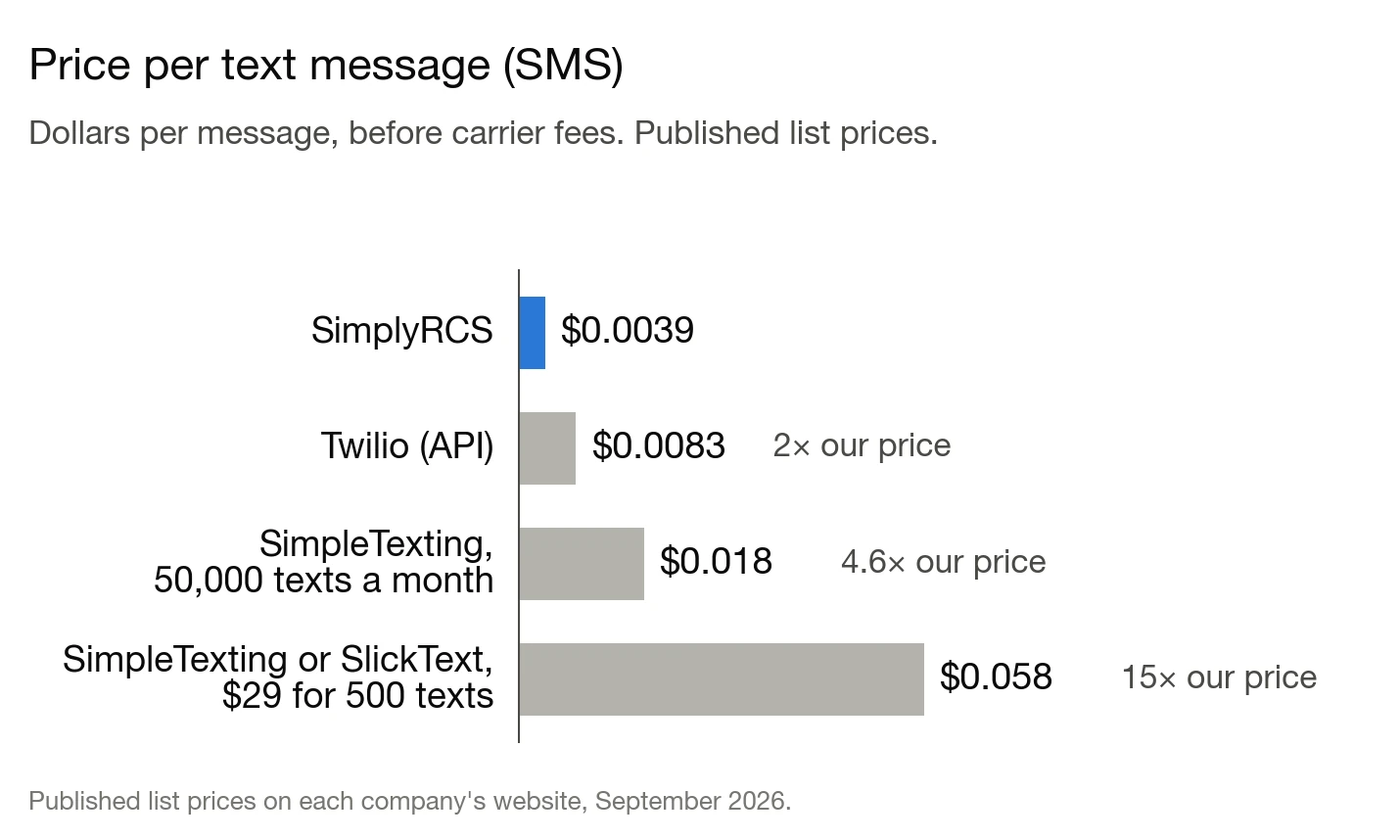
And that's before the extras:
- Seats cost extra. SimpleTexting includes three users and charges $20 a month for each additional user.
- Picture messages cost more. On SimpleTexting, a picture message uses three credits, about $0.165 at its overage rate.
- HubSpot sells texting as a $75-a-month add-on for 1,000 messages, on top of a Pro or Enterprise subscription, and incoming messages count against that limit. According to HubSpot's own product catalog, the texting runs on Twilio.
RCS costs even more, where vendors offer it at all:
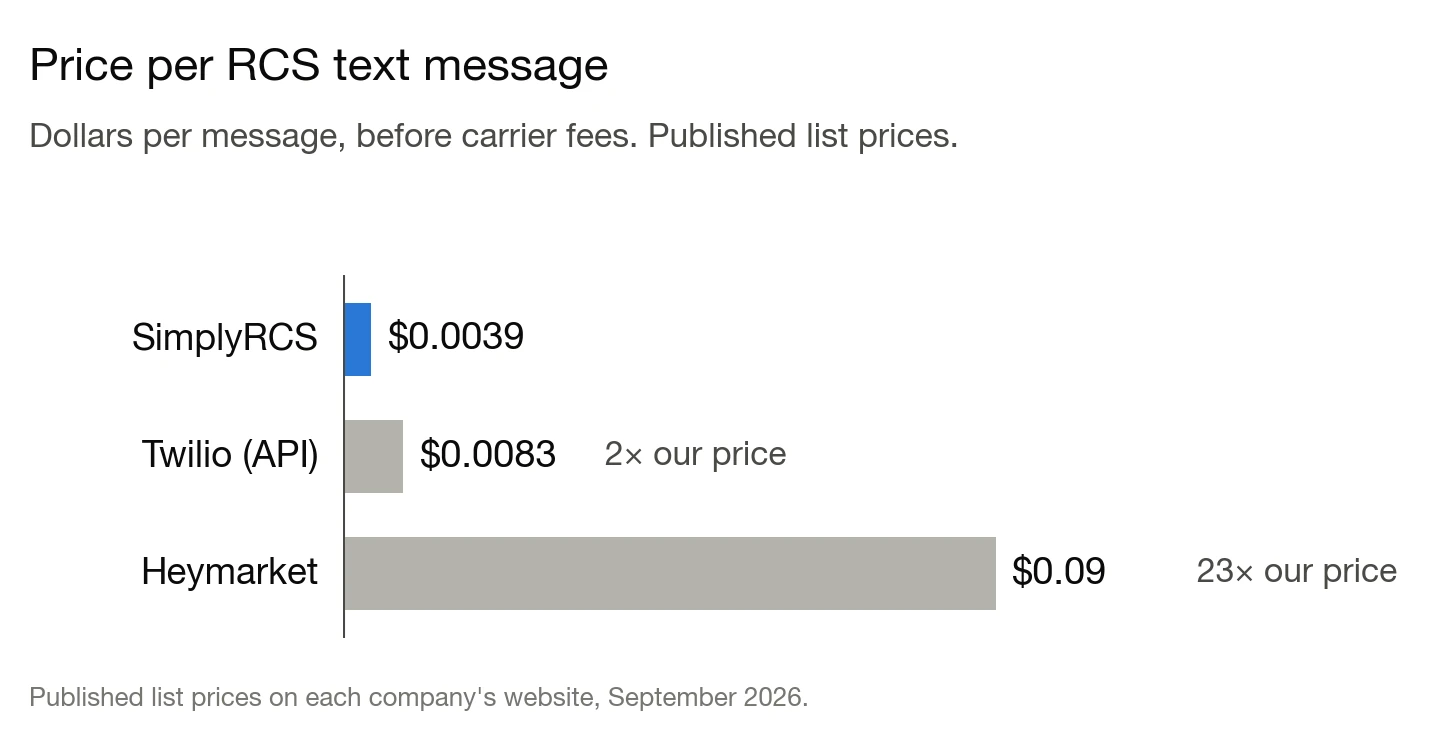
Heymarket offers RCS only on annual plans. SlickText charges a $500 setup fee plus $200 a year just to turn RCS on.
To be fair, those vendors' prices include software: an inbox, automation and support. That's exactly the point. You pay for the software every month, on every message.
This model assumes the software is a moat: once you're on the platform, the code is too hard to replace, so the vendor can charge whatever the market will bear.
Software isn't a moat anymore.
There's a third option. SimplyRCS charges $0.0039 for a text, whether it goes out as SMS or RCS, and passes carrier fees through at cost.[1] The software to actually use RCS is free, and there are people behind it who know the carriers.
Software alone is no longer the product
We believe the era of selling software as a stand-alone product is over. Building software has never been faster or cheaper. A texting app that could command a premium five years ago can now be built by a small team in weeks. When the code is easy to reproduce, charging a premium to use it isn't a business model. It's a toll, and it lasts only until customers notice.
That doesn't mean software companies have nothing worth paying for. The good ones have something genuinely valuable: context. They know their industry and how their customers work, and they've seen what succeeds and what fails. That knowledge is worth paying for. A marked-up subscription to code anyone can write is not.
So we're separating the two. The software is free, and you pay for the parts that are actually hard.
Why open source
SimplyRCS Open Source is the full SimplyRCS application, the same software that runs SimplyRCS Cloud. We'll release it publicly on GitHub by the end of October. If you can't wait, book a time with us and we'll work something out.
We're open-sourcing it for two reasons.
We mean it when we say software isn't the moat. If we thought our code was the valuable part, we'd lock it up. We don't, so we won't.
Some companies won't hand their data to a third party. Customer lists, consent records and message history are sensitive, and some enterprises need them on infrastructure they control. With SimplyRCS Open Source, you run the app on your own servers or in your own cloud and send messages through our API. You get the same features as SimplyRCS Cloud, and your data stays with you.
Why AGPL? It's a true open-source license: you can run, study and change the code. It also requires any company that offers a modified version as a hosted service to publish its changes. We're happy to share, but we won't subsidize a competitor's closed copy.
Want to contribute? If you're interested in contributing to the project, book a time with us. We'd love to hear from you.
Why SimplyRCS Cloud is free
Not every company wants to run its own servers, and it shouldn't have to. SimplyRCS Cloud is the same software, and we host, update and secure it for you. Book a meeting and we'll get you set up.
We don't charge for it, for three reasons.
Charging for it would be hypocritical. We just told you software isn't worth a premium. A subscription to our hosted copy would be the same markup under a different name.
Tools shouldn't be what keeps a business off RCS. For most businesses, the biggest obstacle to RCS is not having the tools to use it. We want to lead this industry's move to RCS, and the fastest way to get there is to remove that obstacle entirely.
Our value isn't the code. Hosting a web app is cheap. What we actually offer is everything around it:
- We're connected to the carriers. We run the connection that actually delivers your messages.
- We know this industry: how carriers approve senders, what the regulations require and why campaigns get rejected.
- We get you verified. We handle brand verification, RCS sender approval, and 10DLC and toll-free registration. We typically get RCS sender IDs approved in under 30 days. While that happens, we run your existing 10DLC or toll-free campaigns, which become your backup once you're live on RCS.
- We keep you delivered and compliant on every channel.
You can copy code. You can't copy that.
Free software doesn't mean free messaging. Here's what you pay for:
- RCS, three ways. You never pay a premium for the better channel.
- RCS text: $0.0039 per message, the same as an SMS.[1]
- RCS rich media (cards, carousels, images and video): $0.015 per message, the same as an MMS.[1]
- Conversational RCS: $0.05 per session, which covers unlimited RCS messages, text or media, for 24 hours. A session starts when a real back-and-forth begins: four messages in 24 hours, at least two of them from your customer. To learn what conversational RCS is and how sessions are billed, see how US RCS billing works.
- Numbers. Local and toll-free numbers are $0.50 a month.[1]
- Carrier surcharges and setup fees, at cost. We pass them through without a markup.
- Support, when you want more than email. RCS Sender ID setup and review is $250 one-time, waived with optional Premium Support. More on both below.
What the carriers charge
Every business text in the US carries a surcharge from the carrier that delivers it, on top of any provider's price:
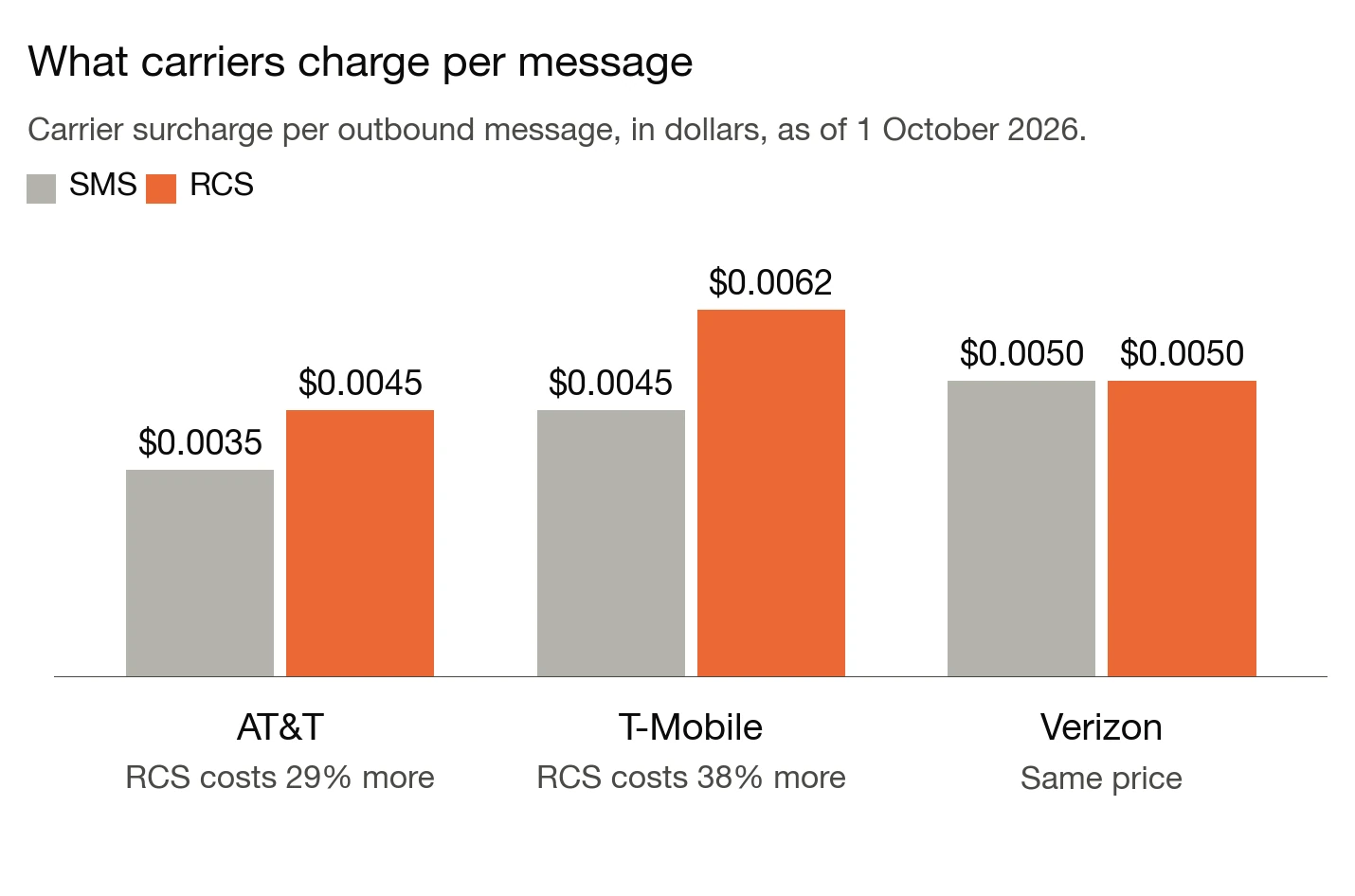
AT&T and T-Mobile charge more to deliver an RCS message than an SMS. Verizon charges the same for both, but not because either price came down: on October 1 it raised both, from $0.0045 to $0.0050, now the highest SMS rate of the three. RCS is the channel built for transparency: it shows your customer exactly who's texting them. The carriers talk about fighting fraud, then make the most trustworthy way to reach a customer more expensive, not less. We think they're wrong.
Conversation pricing is where they differ most. Each carrier also adds a surcharge to every conversational RCS session. It's the same conversation with the same customer, and T-Mobile charges almost seven times what Verizon does:
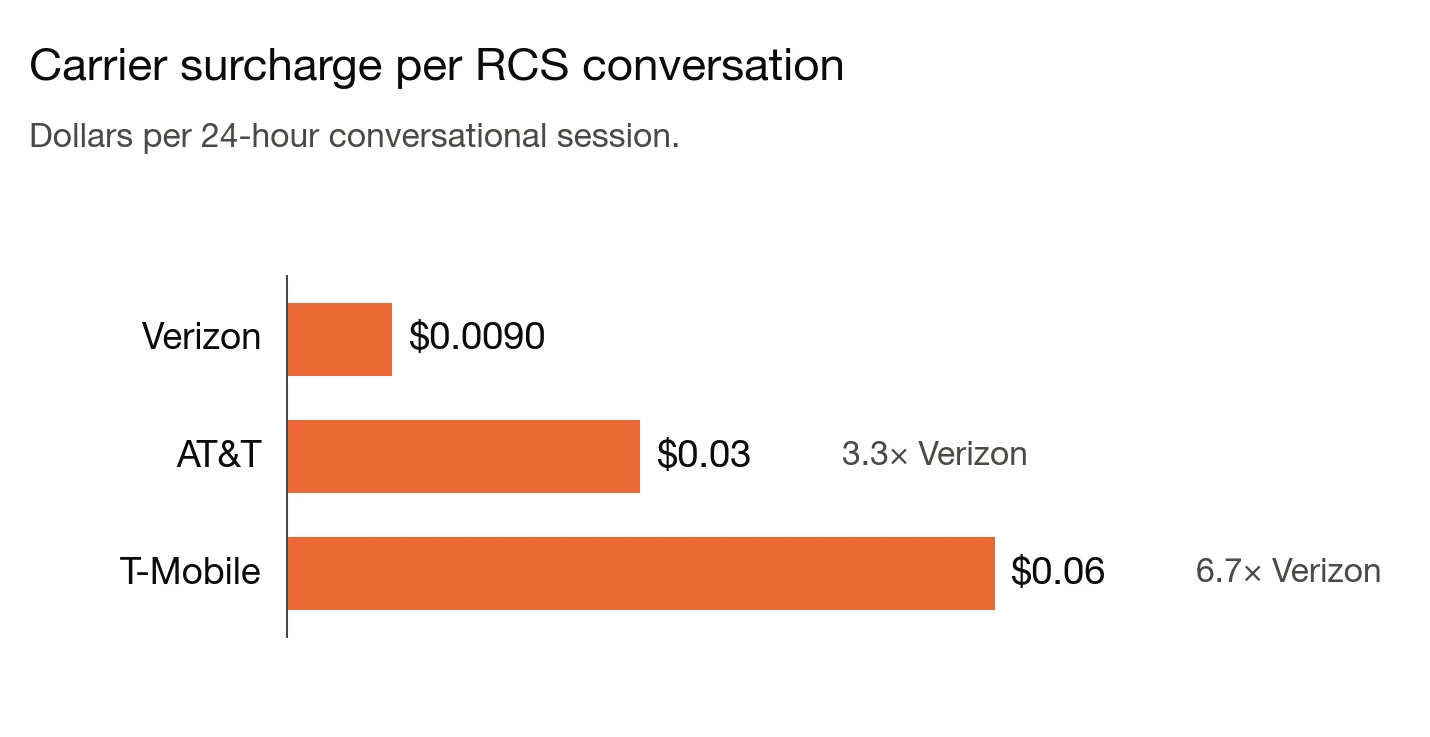
Anyone want to open a Polymarket on how long Verizon's session price stays that low?
Then there's T-Mobile. The self-styled Un-carrier talks a big game about trust and transparency. It also charges $500 just to activate each new RCS sender, and it bills by the megabyte: $0.001 for every megabyte over 5 MB in an RCS media message, whether you send it or receive it. Putting a toll on the most trustworthy way to reach customers is shockingly anti-competitive, and it's coming from the carrier that built its brand on being the good guy.
If history is prologue, these prices only go one way.
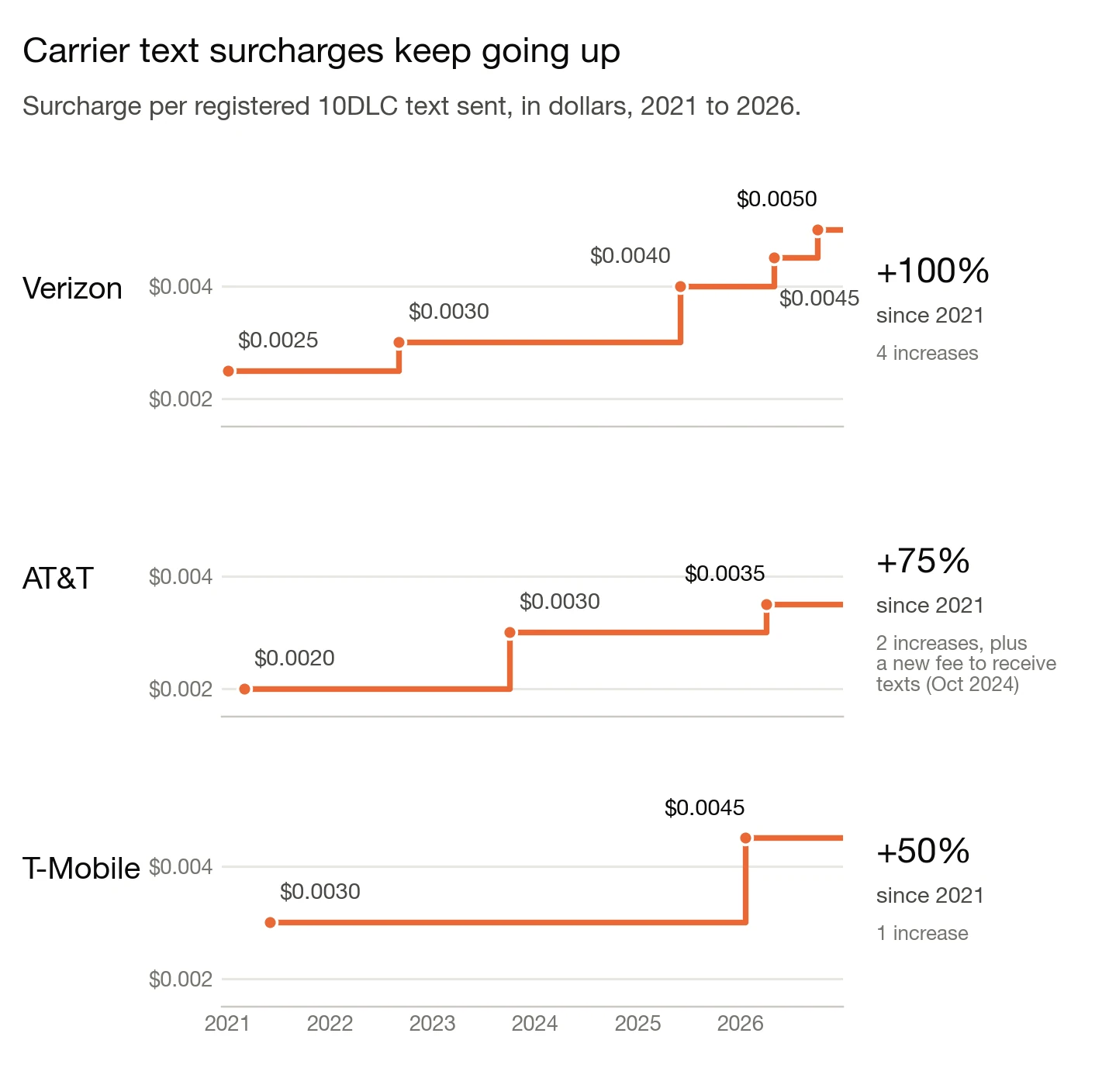
Since 10DLC launched in 2021, Verizon has raised its fee four times, twice in 2026 alone. AT&T has raised it twice and, in 2024, started charging to receive a text as well. T-Mobile raised it 50% in January. In our experience, carriers don't compete on these fees. They compete upward: one raises a fee, and the others follow. And no business can shop around, because each carrier is the only way to reach its own customers' phones. If you want to text a T-Mobile customer, you pay T-Mobile's price. It looks like anti-competitive behavior and collusion, if not legally, then in spirit.
We can't control what carriers charge. We can refuse to add a markup on top, and we do. (I covered these fees in more detail in The Texting Trust Tax.[5])
Who shouldn't be our customer
RCS verification puts your brand under a microscope. That's the point: your customers deserve to know who's texting them.
So let me be direct. If your business depends on blasting people who didn't ask to hear from you, go somewhere else. I'm sure plenty of our competitors will be happy to help you get your predatory campaign approved.
We won't.
Support: a person who knows the carriers
Support is the part of this announcement I care about most, because it's where we're different.
For SimplyRCS Cloud:
- Email support is free for everyone.
- RCS Sender ID setup and review is $250 one-time per sender, waived with Premium Support. We build your sender, review your brand and use case against carrier rules, and take it through approval.
- Premium Support is $250 a month, with no setup fee, and it waives your RCS Sender ID setup and review. You get a named account manager, hands-on help with your RCS sender ID, and compliance consultation across every channel you use.
Premium Support is optional, and you can cancel anytime. We don't think you should, though. Use us as a business partner: set up regular check-ins, and run new marketing ideas by us before you launch them. We see a lot of campaigns, and we know what works and what doesn't.
Running SimplyRCS Open Source? Email support is free for self-hosted users too, and optional support plans are available. Book a time with us and we'll put together what fits.
We'd love to give everyone a dedicated person for free, but that isn't realistic. We're not a big company, and we believe in human connection. For $250 a month, you get a friend who knows the carriers.
The offer
Here's everything in one place:
- SimplyRCS Cloud: the full software, managed by us, free today.
- SimplyRCS Open Source: the same application under AGPL-3.0, free to run on your own infrastructure, on GitHub by the end of October.
- Messaging: $0.0039 per text, whether it goes as SMS or RCS; $0.015 per rich media message; $0.05 per 24-hour conversational session. Carrier fees are passed through at cost.
- Support: free email support for everyone, RCS Sender ID setup and review at $250 one-time (waived with Premium Support), optional Premium Support at $250 a month, and optional support plans for Open Source.
If that sounds like the partner you've been looking for, let's talk.
Book a meeting with SimplyRCS →
References
- SimplyRCS. "Pricing." simplyrcs.ai
- Apple. "App Store: iOS and iPadOS usage," as measured by devices that transacted on the App Store on 7 June 2026. developer.apple.com
- StatCounter. "Mobile operating system market share, United States," August 2026. gs.statcounter.com
- Google. "A billion RCS messages a day." 13 May 2025. blog.google
- Kamrat, N. "The Texting Trust Tax." SimplyRCS, September 2026. simplyrcs.ai